

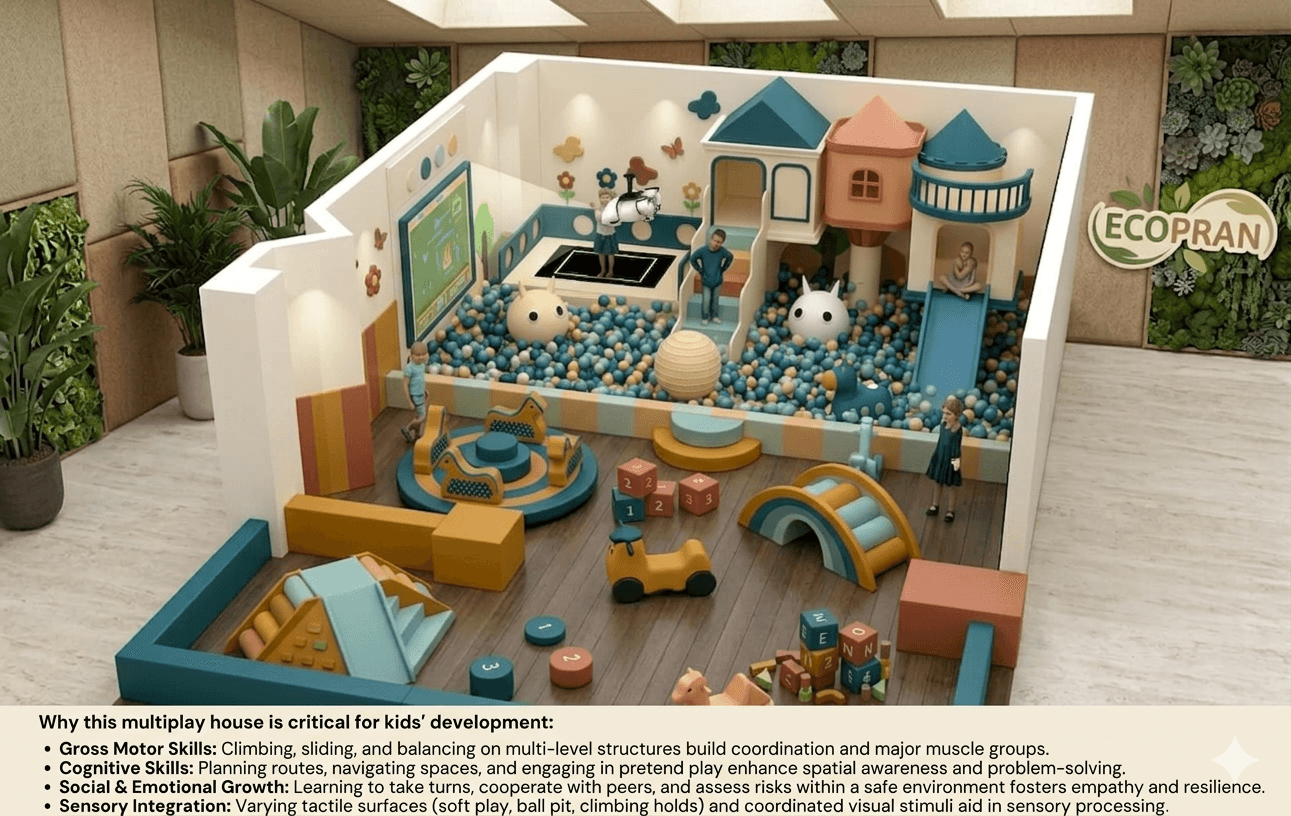
Multiplay houses, especially comprehensive ones that combine soft play, climbing, cognitive challenges, and ball pits, are essential tools for a child’s holistic development. This type of environment supports growth across four key developmental pillars: Physical, Cognitive, Social, and Emotional.
1. Physical Development (Gross and Fine Motor Skills)
-
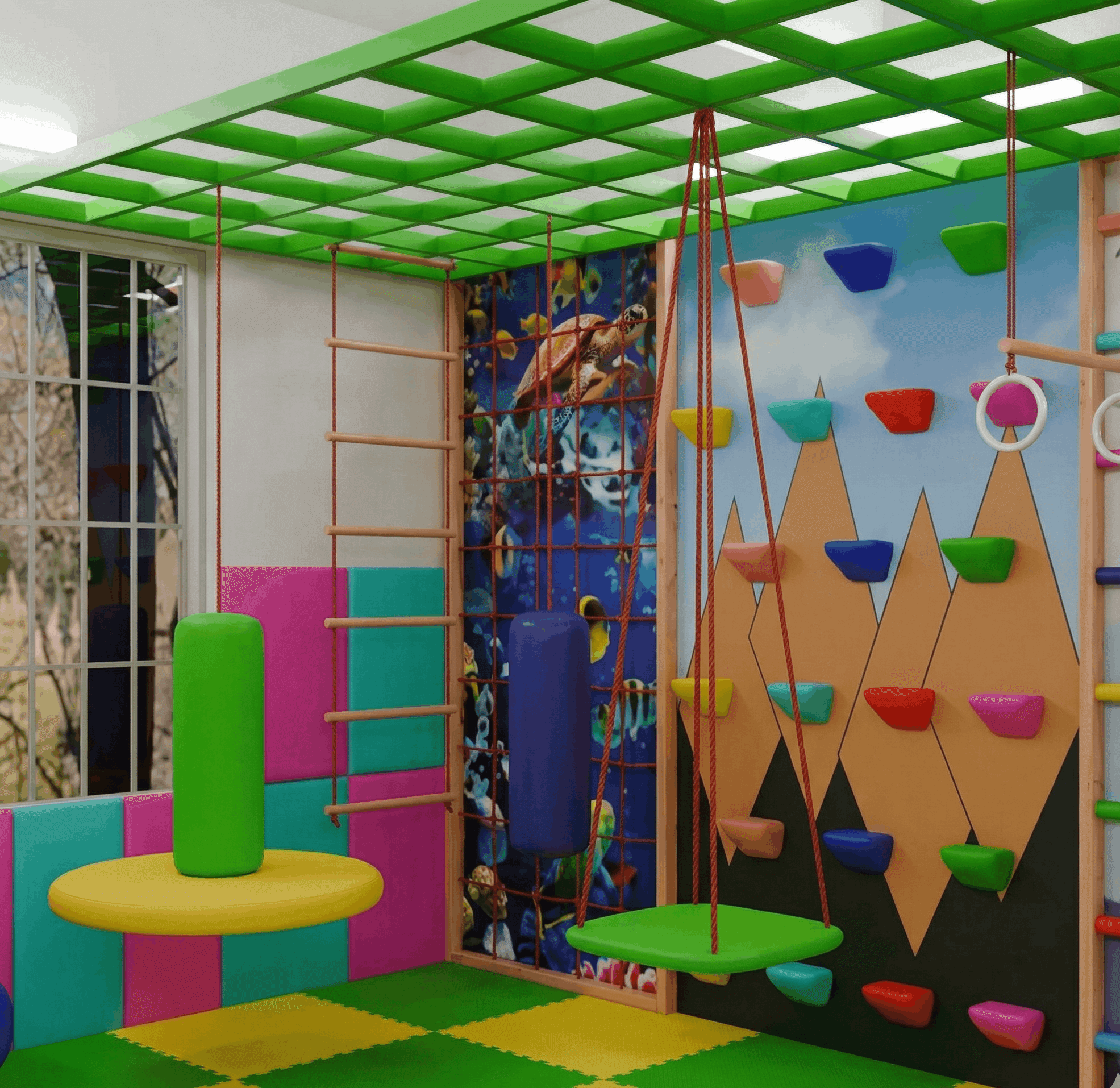
Gross Motor Skills: The core of the design is encouraging movement. The slides, stairs, and multi-level structures require children to climb, crawl, balance, and slide, which strengthens their large muscles, improves coordination, and develops spatial awareness. The climbing wall section teaches complex muscle sequencing and grip strength.
-
Fine Motor Skills: Smaller elements, like the alphabet blocks and soft toys in the foreground, encourage reaching, grasping, and stack-building, which refines fine hand-eye coordination.
-
General Health: In an era of increasing sedentary behavior, an engaging indoor playground provides essential physical activity regardless of the weather, promoting a healthy cardiovascular system and strong bone density.
2. Cognitive Development (Problem Solving and Executive Function)
-
Pathfinding and Planning: As kids navigate the interconnected levels, they must think strategically: “How do I get from the bottom stairs to the blue slide?” This encourages sequential thinking and problem-solving.
-
Spatial Reasoning: Movement through ball pits, tunnels, and structures requires a deep understanding of their body in relation to their environment, which is a key component of spatial reasoning.
-
Imaginative Play: The castle-like design inherently encourages role-playing. “Pretend play” is a sign of high-order cognitive development, as it allows children to process real-world scenarios in a safe environment.
3. Social and Emotional Development (Cooperation and Risk Assessment)
-
Social Interaction and Conflict Resolution: Multiplay houses are social hubs. Children must learn to share space, take turns on the slide, and cooperate to move together through tight spaces. This is where early social cues, empathy, and negotiation skills are developed.
-
Building Confidence and Risk Management: Every climb is a lesson in calculated risk. When a child successfully navigates a tricky section (like climbing the stairs to a slide for the first time), it builds significant self-confidence and a sense of mastery. They learn to evaluate their limits.
-
Emotional Regulation: If a child becomes frustrated by a challenge, a safe play environment allows them to work through that frustration with a tangible goal, developing resilience.
4. Sensory Integration (Processing the World)
-
Tactile and Proprioceptive Input: The varying surfaces—wood grain, soft upholstery, plastic balls, and climbing holds—offer diverse tactile feedback. The ball pit, in particular, provides pressure and buoyancy, which is essential for sensory processing.
-
Visual Stimulation: A thoughtfully colored environment, especially the rich new teal and ochre palette, stimulates the optic nerves without being overwhelming, aiding in visual discrimination and focusing attention.
A well-designed multiplay house, such as this ECOPRAN model, acts as a comprehensive “learning laboratory” masked as pure fun, ensuring that every time a child plays, they are building a crucial foundation for their future.
Reviews
There are no reviews yet.