

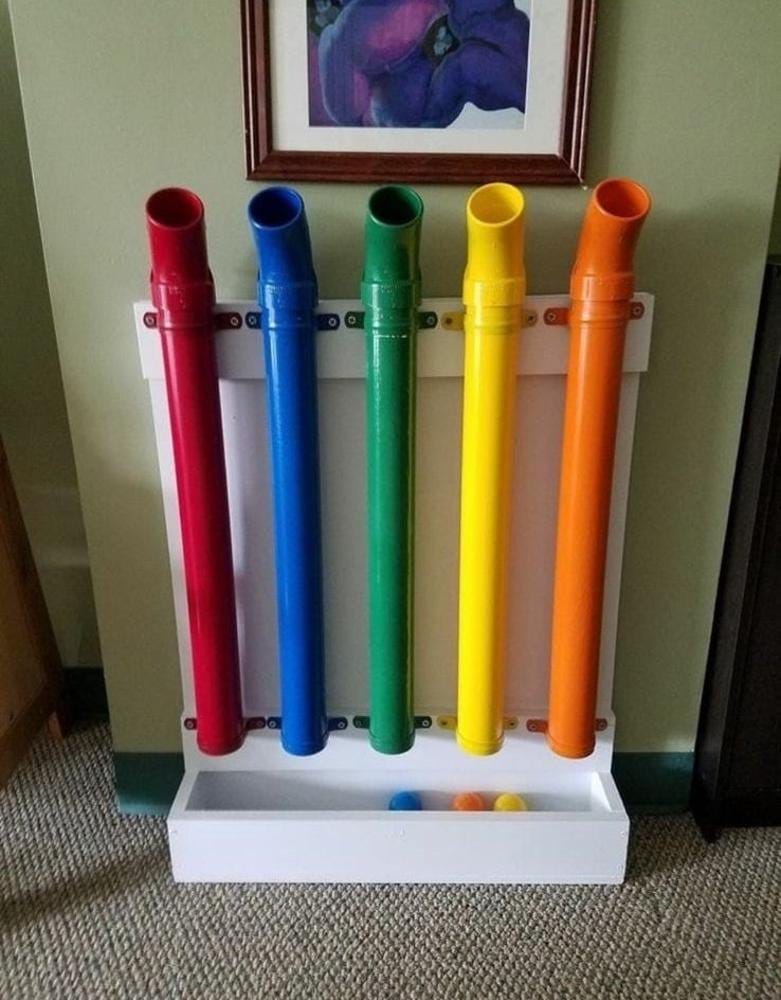
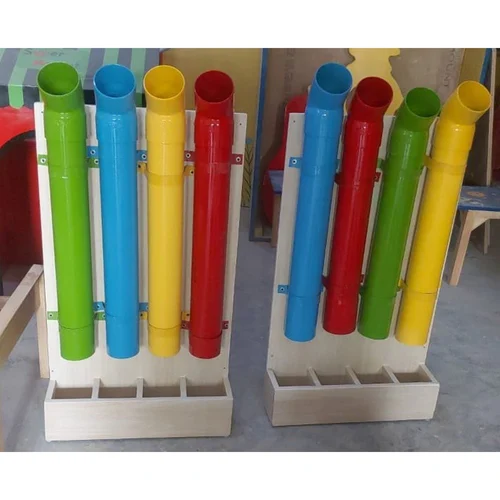
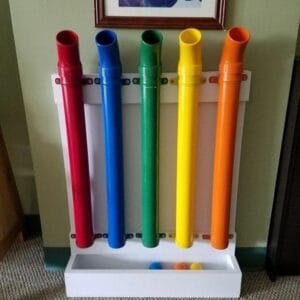
This colorful ball-drop equipment is a classic example of STEM-based play (Science, Technology, Engineering, and Math). It is designed to turn a simple action—dropping a ball—into a powerful learning experience for a child’s developing brain.
Here is why this type of equipment is essential for kids:
1. Cognitive Development: Cause and Effect
This is one of the first scientific lessons a child learns.
-
Predictive Thinking: By dropping a ball in the top and watching it disappear, then reappear at the bottom, a child learns Object Permanence (knowing something exists even when you can’t see it).
-
Gravity and Physics: Children begin to understand that objects fall down, not up, and they can observe the speed and momentum of the ball as it travels through the tube.
2. Fine & Gross Motor Skills
Playing with this station requires physical precision:
-
Eye-Hand Coordination: The child must align the small ball with the opening of the tube. This builds the same neural pathways used for writing and drawing later in life.
-
Grasp and Release: Picking up the balls and releasing them at the right moment strengthens the small muscles in the hands and fingers.
-
Reach and Stretch: If the tubes are tall, children have to stand on their tiptoes or reach up, which improves their balance and core stability.
3. Logic and Categorization
The use of 5 distinct colors (Red, Blue, Green, Yellow, Orange) isn’t just for decoration; it’s a teaching tool.
-
Color Matching: You can encourage a child to “Put the red ball in the red tube.” This strengthens their ability to recognize and categorize information.
-
Sorting Skills: Sorting objects by color is a fundamental pre-math skill that helps children understand sets and groups.
4. Sensory and Auditory Stimulation
-
Sound Tracking: The “clunk” or “woosh” sound the ball makes as it travels through the plastic tube provides auditory feedback. This helps children track the movement of objects using their ears as well as their eyes.
-
Tactile Experience: Handling the smooth balls and the hard tubes provides different textures for a child to explore.
5. Independent and Social Play
-
Focus and Concentration: This activity is “repetitive” in a way that children find deeply satisfying. It can keep a child focused for long periods, which increases their attention span.
-
Turn-Taking: If multiple children are playing, they learn social skills like waiting for their turn and sharing the different colored tubes.
Why this specific design works:
-
Wall-Mounted: It saves floor space and keeps the play area organized.
-
Vertical Orientation: It encourages children to move from a sitting to a standing position.
-
Simple & Durable: There are no electronic parts to break, meaning it encourages “active” play rather than “passive” screen time.
Are you looking to install this in a classroom or a home playroom? I can suggest some great ways to DIY this or where to find similar sensory equipment!
Reviews
There are no reviews yet.